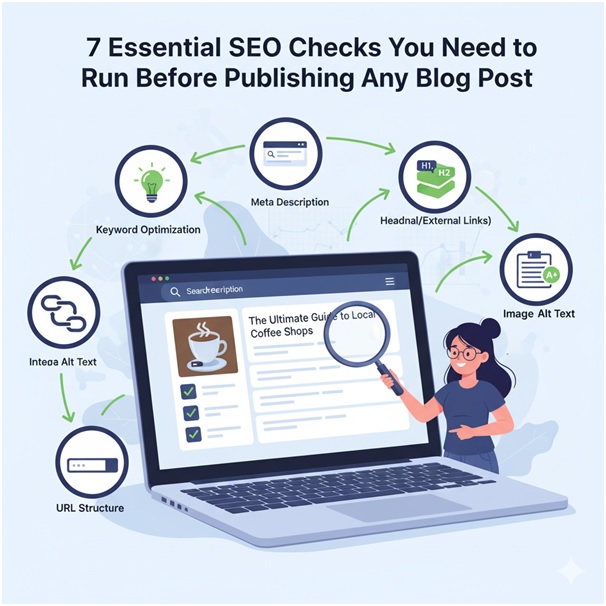
A blog is like putting up a store without a signboard; unless there are some SEO checks done before posting a blog post, nobody will be aware of its existence. A couple of basic SEO checks before you start hitting that publish button are what will assure you that at least your content can be seen, found, and competitive.
These checks also increase user experience and blog credibility in addition to ranking better. Seven critical questions to consider in your pre-publishing SEO process are given below.
1. Have You Researched and Integrated the Right Keywords?
The success of SEO is based on keyword research. Find the main keywords and the second important ones, which are related to the user intent prior to writing – use Google Keyword Planner, SEMrush, or Ahrefs. After you recognize them, add them in a normal fashion into your title, headings, meta description, and the first 100 words of your post. For strategizing, use templatables for Remarkable 2 for noting all the essential ideas.
Keywords should not be stuffed, but only semantically relevant and context-dependent. Properly researched keywords will see your post being where your audience is searching.
2. Is Your Title Optimized for Both SEO and Clicks?
To capture search engines and the human eye, your title has to be appealing. An SEO-friendly title must contain your key keyword, preferably at the start, but it must also be interesting and human. Such as, rather than “How to Run SEO Checks,” put in 7 Essential SEO Checks You Must Run Before Publishing Any Blog Post.
Limit the title to fewer than 60 characters to make it appear complete in search results, and use emotional words or action-oriented words to increase the rate of clicking through.
3. Have You Written an Engaging and Optimized Meta Description?
Your post elevator pitch in search results is your meta description. It must be a summary of what you are saying, must contain your target keyword, and must not exceed 150-160 characters. For instance:
“Ensure your blog ranks higher — discover 7 must-do SEO checks before publishing to boost visibility, traffic, and engagement.”
An interesting meta description is known to promote CTR (Click-Through Rate), indicating to Google that the material is worth using by users.
4. Are Your Headers (H1, H2, H3) Structured Properly?
Headings help search engines to figure out the hierarchy of your content. Each of the posts is supposed to consist of one H1 (the main title) and those of H2s and H3s (subtopics). It not only increases readability, but it also increases on-page SEO.
Your subheadings should use keywords and related phrases to make Google refer your post to the related search queries. The proper analysis of the header layout will help your content be simple to scan, which is key to both users and algorithms.
5. Have You Optimized Your Images and Media Files?
Pictures make your post lively, but may reduce page loading in case they are not optimized. Reduce the size of images with programs such as TinyPNG or ImageOptim, and then upload. Add a text with the description of the image and keywords related to the image- description increases accessibility and makes your content perform better in image search. One can use Happy Downloads templates to keep track of all the image sources.
Also, name the image files in a descriptive manner (e.g., seo-checklist-blog.png, and not IMG1234.png). Optimized images and other visuals that can be loaded quickly have the potential to boost your Core Web Vitals score, which is a determining factor in overall ranking.
A combination of technical optimization and creative storytelling can make any post a high-performing digital asset.